In open parklands of the American West, brilliant blue-and-rust Western Bluebirds sit on low perches and swoop lightly to the ground to catch insects. Deep blue, rusty, and white, males are considerably brighter than the gray-brown, blue-tinged females. This small thrush nests in holes in trees or nest boxes.
Western Bluebirds often gather in small flocks outside of the breeding season to feed on insects or berries, giving their quiet, chortling calls.
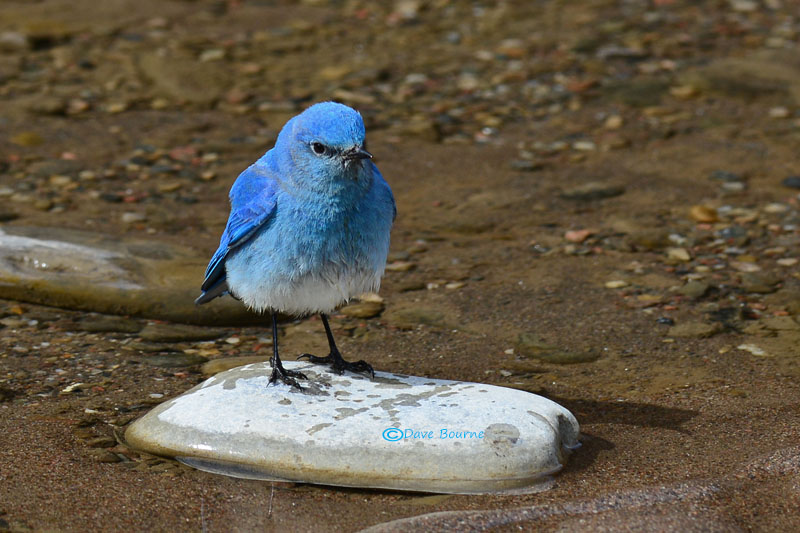
Mountain Bluebirds are fairly small thrushes with round heads and straight, thin bills. Compared with other bluebirds they are lanky and long-winged, with a long tail.
I photographed this Mountain Bluebird alongside a small stream in the Rocky Mountains in Colorado.
Male Mountain Bluebirds are sky-blue, a bit darker on wings and tail and a bit paler below, with white under the tail. Females are mostly gray-brown with tinges of pale blue in the wings and tail.
Unlike other bluebird species, Mountain Bluebirds often hover while foraging; they also pounce on their insect prey from an elevated perch. In winter, the species often occurs in large flocks wandering the landscape feasting on berries, particularly those of junipers. Cornell All About Birds.
I photographed this Mountain Bluebird right here in Lambton County on Kerry Road back in 2012. As I was using my images to backfill my ebird sightings it was very interesting to see who had gone to see the bird the same day as me. Many people who I would later become friends with.
Male Eastern Bluebirds are vivid, deep blue above and rusty or brick-red on the throat and breast. Blue in birds always depends on the light, and males often look plain gray-brown from a distance. Females are grayish above with bluish wings and tail, and a subdued orange-brown breast.
Eastern Bluebirds live in meadows and openings surrounded by trees that offer suitable nest holes.
With the proliferation of nest boxes and bluebird trails, bluebirds are now a common sight along roads, field edges, golf courses, and other open areas. Cornell All About Birds
With a golden head, a white patch on black wings, and a call that sounds like a rusty farm gate opening, the Yellow-headed Blackbird demands your attention. Look for them in western and prairie wetlands.
In 1825 Charles Lucien Bonaparte, nephew of Napoleon Bonaparte, gave the first detailed description of the Yellow-headed Blackbird, which was collected in 1820 by Thomas Say and Sir John Richardson.
Pleistocene fossils of Yellow-headed Blackbirds (from 100,000 years ago) have been dug up in California, New Mexico, and Utah. Cornell All About Birds
Although I have seen Yellow-headed Blackbirds out west numerous times it was great to observe one in Lambton County.
It was ten years ago when I observed my first Black-necked Stilt. We were on a Princess Cruise in the Caribbean, something we have only done a couple of times, when we went on a shore excursion arranged by Princess. Usually we arrange our own guides as I feel not only do you get an infinitely better experience but it also feels very good supporting local birders.
The excursion was basically transportation to Bird Island where you birded on your own for the morning. It was one of our first times in the Caribbean and we observed many life birds.
On the way back to the ship we stopped at a “Wilderness Park” which was a very rundown zoo, with birds and animals living in very poor conditions. I could not bring myself to wander through the park and we explained to the rest of the group we would wait outside. It was then that I noticed a large swampy reservoir behind the park and we proceeded down the gravel path to check it out.
It was loaded with birds. The Black-necked Stilts, White and Scarlet Ibis, Yellow-crowned Night Herons, Whistling Ducks, various other shorebirds, etc., etc.
The Black-necked Stilt is a tall but small-bodied shorebird with very long legs, a long neck, small head, and thin, straight bill.
These birds are black above and white below, with white around the eye and rosy pink legs. In females and immatures the black areas can be brownish.
Black-necked Stilts wade into shallow bodies of water, seldom swimming, in pursuit of tiny aquatic invertebrates. Adults defending nests or chicks fly around and call loudly, sometimes performing a distraction display by feigning injury.
Black-necked Stilts are almost always seen near shallow water, including both salt and fresh water, especially mudflats, salt pans, saltmarshes, and many human-modified habitats such as sewage ponds, evaporation pools, and flooded fields. Cornell All About Birds
Although I have observed Black-necked Stilts in the United States and Caribbean it was cool to see my first ever in Lambton County.
The Eastern Kingbird is a sturdy, medium-sized songbird with a large head, upright posture, square-tipped tail, and a relatively short, straight bill.
Eastern Kingbirds often perch in the open atop trees or along utility lines or fences. They fly with very shallow, rowing wingbeats and a raised head, usually accompanied by metallic, sputtering calls.
Eastern Kingbirds are visual hunters, sallying out from perches to snatch flying insects. Cornell All About Birds
The American Oystercatcher is a large, thickset shorebird with a long, stout bill, a large head, robust neck, and long, thick legs.
American Oystercatchers look black-and-white from a distance, with a bright orange-red bill. At closer range, the back and wings are brown, with a black head and breast, white underparts, yellow eye, and red eyering.
In flight, look for a white wingbar and white tail base.
American Oystercatchers probe sandy and stony areas for clams, oysters, and other mollusks, which they open by cutting or smashing.
Habitat is barrier islands and beaches, saltmarshes, and shellfish reefs.
Cornell All About Birds
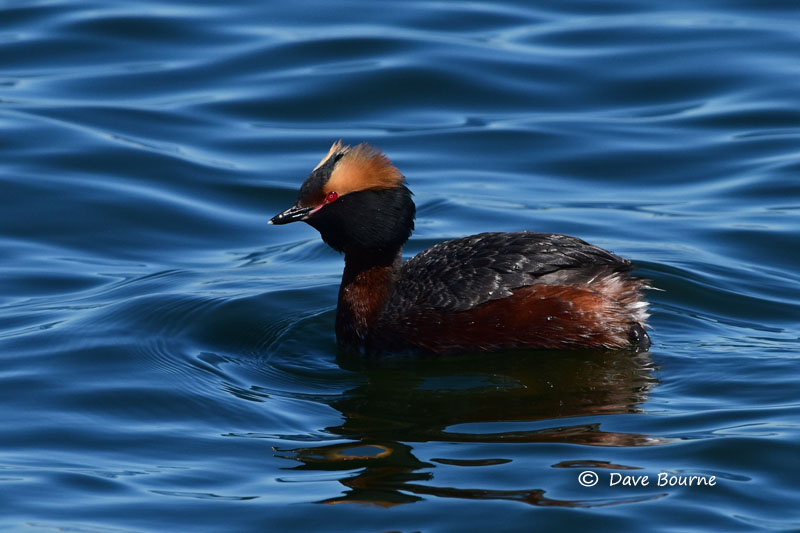
Familiar to most North American birders in its black-and-white winter plumage, the Horned Grebe is more striking in its red-and-black breeding feathers. Its "horns" are yellowish patches of feathers behind its eyes that it can raise and lower at will.
The Horned Grebe regularly eats some of its own feathers, enough that its stomach usually contains a matted plug of them. This plug may function as a filter or may hold fish bones in the stomach until they can be digested. The parents even feed feathers to their chicks to get the plug started early. Cornell All About Birds
Here is a series of shots featuring a diving Osprey.
Just before hitting the water the Osprey turns talons first.
There were 3 frames of the Osprey completely under the water before it emerged.
The getaway image features a finely crafted poop out.
Ospreys are very large, distinctively shaped hawks. Despite their size, their bodies are slender, with long, narrow wings and long legs.
Ospreys fly with a marked kink in their wings, making an M-shape when seen from below.
Look for Ospreys around nearly any body of water: saltmarshes, rivers, ponds, reservoirs, estuaries, and even coral reefs.
Their conspicuous stick nests are placed in the open on poles, channel markers, and dead trees, often over water.
While in the Caribbean we watched this Osprey pick up coconuts and drop them onto the rocks to split them open.
Tomorrows blog will feature some Osprey dive images.