Tuesday, December 21, 2021

Yellow-billed Stork


The Yellow-billed Stork is a large, mostly white stork with a distinctive yellow bill and bright red facial skin. It is more tied to wetland habitats than most other storks, and it forages with its bill partially submerged and open, stirring up prey in muddy pools with its feet.


When it encounters prey it snaps its bill closed. It is a resident and partial migrant throughout its range, and although not particularly gregarious, it will congregate when food is abundant.

The similar White Stork has a white (not black) tail, and it lacks the red facial skin and yellow bill of the Yellow-billed Stork. ebird

Monday, December 20, 2021

Black-winged Lapwing

The Black-winged Lapwing is a large, long-legged, upland shorebird with a brown back, a white belly, and a dark gray hood.


Found in grassland and cultivation; only at high elevations over much of its range. ebird

Sunday, December 19, 2021

Blacksmith Plover


The Blacksmith Plover, or Blacksmith Lapwing, is a gray, black, and white lapwing with a white crown and black face and breast. Immatures are mostly brownish.


It is a common breeding resident that is strongly tied to wetlands, although it may also disperse into flooded grassland and adjacent dryland habitats to forage.

Bold and brave parents, Blacksmith Lapwings have been known to launch defensive attacks on African Elephants and harass aerial threats like rollers or raptors in order to protect their young.

A loud ringing “tink-tink-tink” call is uttered in series, like a blacksmith hammering on an anvil.

Saturday, December 18, 2021

Hadada Ibis

Our next stop on our East Africa safari took us to Sweetwaters Tented Camp on the Laikipia Plateau in Kenya directly on the equator.


The Hadada Ibis is a large, bulky, gray-brown ibis with an iridescent green-purple gloss on the wings. It has a bicolored black-and-red bill and a white streak across the cheek under the eye.


Pairs and small flocks occur in a variety of habitats including open country, wetland margins, and forest edge. They forage on the ground, digging, probing soft soil, and picking up invertebrates with their long bills.


The frequently-heard call is one of the most characteristic sounds of Africa: a loud, raucous, trumpeting “ha-da-da” which gives the bird its name.

Friday, December 17, 2021

Samburu National Preserve trees

A couple of the more common trees found in Samburu National Preserve are the Acacia Tree and the Coconut Palm Tree.


                                                Acacia Tree with Weaver nests.


                                             Coconut Palm Tree at a waterhole

Tomorrow we will move on to the birds and wildlife on the Laikipia Plateau near Sweetwaters Serena Tented Camp.

Thursday, December 16, 2021

Kirk' Dik-dik


Kirk’s dik-diks are tiny antelopes that vary in color depending on their habitat but are typically yellowish-gray to reddish-brown on its back and grayish-white on their belly.


Males have horns that are ringed and stout at the base, which are often concealed by a tuft of hair on their forehead. These antelopes have beautiful, large, dark eyes surrounded by a white ring.

And while their eyes are stunning, they provide more than just sight. Preorbital glands appear as a black spot below the inside corner of each eye. These glands produce a dark, sticky secretion used to scent-mark their territories.

The most distinguishing feature is their elongated snout, which is also an evolved cooling mechanism that stops them from overheating, even in extreme temperatures of up to 40°C (104°F). This also helps minimize their need for water.

Wednesday, December 15, 2021

Grant's Gazelle


There are three subspecies of Grant’s gazelle. This species of gazelle resemble Thomson's gazelles, who we seen later in our safari, but are noticeably larger and easily distinguished by the broad white patch on the rump that extends upward onto the back.


Some varieties of Grant's have a black stripe on each side of the body like the Thomson's, but all have a black stripe that runs down the thigh. In others, the stripe is very light or absent.


Their lyre-shaped horns are stout at the base, clearly ringed and measuring 50 to 80 centimeters long (20 to 31 inches). Females have black skin surrounding the teats with white hair on the udder.


Tuesday, December 14, 2021

Black-faced Vervet Monkey


The Black-faced Vervet Monkey is a small, black-faced monkey, common in East Africa.


There are several subspecies of Vervet monkeys, but, generally, the body is a greenish-olive or silvery-gray.


The face, ears, hands, feet, and the tip of the tail are black, but a conspicuous white band on the forehead blends in with the short whiskers.


The males are slightly larger than the females and easily recognized by a turquoise-blue scrotum and red penis. The Vervet is classified as a medium- to a large-sized monkey. The tail is usually held up, with the tip curving downward, and the arms and legs are approximately equal lengths. African Wildlife Foundation


While having breakfast in the dining tent one morning a Vervet Monkey swung down from above, jumped on my shoulder, grabbed and ate a boiled egg off my plate, then grabbed my banana, jumped over to the railing, and proceeded to peel and eat it in front of us.

Monday, December 13, 2021

African Elephants part 2

Some images of African Elephants roaming the savannah.  


This image was taken from the front of our tent.


This image was also taken from in front of our tent. Note the Grey-headed Kingfisher!


Our tent in Samburu National Reserve.


Sunday, December 12, 2021

African Elephant


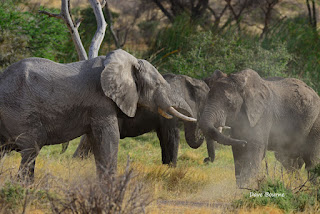
One of the greatest experiences in Samburu National Park was just sitting watching the giant African Elephants socialize.


It was really incredible to watch as they jostled with each other. This was a breakthrough experience between us and our guide who enjoyed our sense of wonder just watching nature. He explained that too many people just want to tick off the animals that they see and not actually sit and enjoy them. From this point on it was always us who determined when it was time to move along in search of something else.


African Elephants are the largest animals walking the Earth. Their herds wander through 37 countries in Africa.


They are easily recognized by their trunk that is used for communication and handling objects.


And their large ears allow them to radiate excess heat.


Upper incisor teeth develop into tusks in African elephants and grow throughout their lifetime.


There are two species of African elephants—the savanna (or bush) elephant and the forest elephant. Savanna elephants are larger than forest elephants, and their tusks curve outwards.


In addition to being smaller, forest elephants are darker and their tusks are straighter and point downward. There are also differences in the size and shape of the skull and skeleton between the two species. WWF