Saturday, December 11, 2021

Gerenuk


The Gerenuk, whose name means “giraffe-necked” in Somali, is an exceptionally long-necked antelope.


Their head is small for their size, but their eyes and ears are large. Only the males have horns, which are stout and heavily ringed, and they have a more heavily muscled neck than the females do.
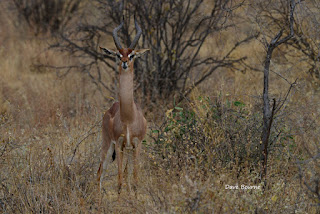

They have a coat that is brown on the upper back and lighter on the sides. The short tail looks longer as it ends in a tuft of black hair. Like many other gazelles, these large antelopes have preorbital glands in front of the eyes that emit a tar-like, scent-bearing substance they deposit on twigs and bushes to mark their territory. They also have scent glands on their knees that are covered by tufts of hair and between their split hooves. African Wildlife Federation

Friday, December 10, 2021

Olive Baboon


Olive Baboons are found throughout equatorial Africa from Senegal, east to northern Zaire, Ethiopia, Kenya, Uganda, and northern Tanzania. We would see large herds of baboons moving across the savannah.


Olive Baboons occupy many different habitats over their large range. A common habitat to find them is the savanna, but other areas include moist, evergreen forests, open grassland, rocky cliffs, dry woodland, desert habitats, and in areas near human settlements.


They cover all areas from the floors of steep valleys to altitudes of over 2300 m and survive well in places where there is varied rainfall, hot climates and frequent drought interspersed with seasons of local rains.


Baboons are omnivorous. They are experts at finding food in all the environments where they range, on the ground, in the trees, underground. They eat a variety of grasses, seeds, roots, leaves, fruit, bark, invertebrates (i.e. grasshoppers, spiders, scorpions and fresh and saltwater shellfish), lizards, turtles, frogs, fish, eggs and young of nesting birds, crocodile eggs, and young mammals. Toronto Zoo

Thursday, December 9, 2021

Black-backed Jackal


The Black-backed jackal is a canid species with long and thin body. Females are a bit smaller and lighter in weight.


The head of a jackal is dog-like with pointed ears and muzzle. On its back, the jackal has a long dark saddle, stretching from the nape of its neck to the base of its tail. The saddle narrows from shoulders to the base of the tail. 


These jackals have bushy tails, which are black in color. The head, ears, back and basal third of the tail are deep russet-red in color with darker top of the muzzle and thighs. Animalia

Wednesday, December 8, 2021

Nile Crocodile


The Nile Crocodile is Africa’s largest crocodilian and can reach a maximum size of about 20 feet and weigh up to 1,650 pounds. Average sizes, though, are more in the range of 16 feet and 500 pounds.


They live throughout sub-Saharan Africa, the Nile Basin, and Madagascar in rivers, freshwater marshes, and mangrove swamps.


As with most of our tented camps we were located on waterholes or river banks. This image was taken from the front of our tent. The croc from the above images is the same croc.

The diet of the Nile Crocodile is mainly fish, but it will attack almost anything unfortunate enough to cross its path, including zebras, small hippos, porcupines, birds, and other crocodiles. It will also scavenge carrion, and can eat up to half its body weight at a feeding.


Tuesday, December 7, 2021

Common Waterbuck


The Common Waterbuck are large, robust animals. The males are generally about 25 percent larger than the females. They have large, rounded ears and white patches above the eyes, around the nose and mouth, and on the throat.


Only the males have horns, which are prominently ringed and as long as 100 centimeters (40 inches). The horns are widely spaced and curve gracefully back and up. They are sometimes used with lethal results when males fight one another over territories.

Monday, December 6, 2021

Warthog


The common warthog is a wild member of the pig family found in grassland, savanna, and woodland in sub-Saharan Africa.


The warthog is a tough, sturdy animal. Males weigh 9 to 23 kilograms (20 to 50 pounds). Females slightly less, however both are distinguished by disproportionately large heads and “warts” , thick protective pads that appear on both sides of the head. 


Their large tusks are unusual: the two upper tusks emerge from the sides of the snout to form a semicircle; the lower tusks, at the base of the uppers, are worn to a sharp-cutting edge. Sparse bristles cover their body, and longer bristles form a mane from the top of the head down the spine to the middle of the back. 


Their long tail ends with a tuft of bristles. Warthogs characteristically carry their tails upright when they run, the tuft waving like a tiny flag. African Wildlife Foundation

Sunday, December 5, 2021

Reticulated Giraffe


Samburu National Park also offered us our first look at African wildlife. The very first animal we seen, and truly one of the most beautiful, was the absolutely gorgeous Reticulated Giraffe.


Our first observation was watching them gracefully guide across the savannah.


The striking intricate patterns on these giraffes is incredible.


Giraffes have basketball size hearts in order to pump the blood to the head and extremely long tongues.


Giraffes are the tallest mammal in the world and can run up to 35 mph for short distances but can cruise 10 mph over longer distances.


Saturday, December 4, 2021

Grevy's Zebra

The long-legged, endangered Grevy’s Zebra is the largest of the zebra species.


Quite often we seen zebras standing side by side looking in opposite directions. A good safety precaution.


It is distinguished by its unique stripes, which are as distinctive as human fingerprints. The Grevy’s are more closely related to the wild ass than the horse, while the plains zebra is more closely related to the horse. Grevy’s also are taller, have larger ears, and have narrower stripes than plains zebras.

Friday, December 3, 2021

Beisa Oryx

The Beisa Oryx has long, straight horns and stunning face markings.


Black lines streak across its nose, forehead, and down its cheeks, creating a mask-like appearance over its otherwise white head. Black badges mark its forelegs and chest.

Thursday, December 2, 2021

Impalas


Impalas are medium-sized antelopes that roam the savanna and light woodlands of eastern and southern Africa.


In the rainy season, when food is plentiful, they may gather in large herds of several hundred animals to browse on grasses and herbs, bushes, shrubs, and shoots.


Impalas are fleet runners who are able to leap distances of up to 33 feet.


Impalas have a symbiotic relationship with Oxpeckers as seen here. Even hanging on for a free ride.