The Cuban Green Woodpecker is a species endemic to Cuba. This green-backed woodpecker has a red crown and a white face with a blackish stripe extending backwards from the eye.
Thursday, May 9, 2024
Tuesday, May 7, 2024
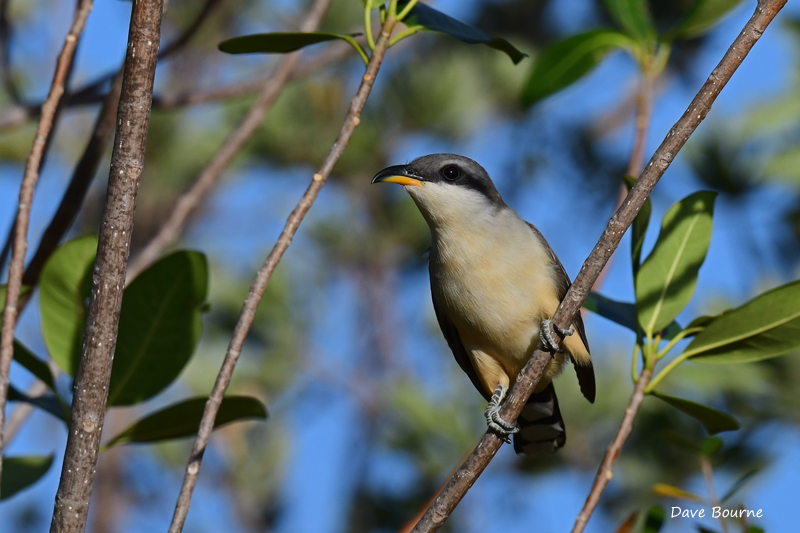
Mangrove Cuckoo
Mangrove Cuckoos are another quite common bird out on Cayo Coco Cuba. It’s not long after you start birding in the morning before the familiar call of the Mangrove Cuckoo is heard.
Like other cuckoos, the secretive Mangrove Cuckoo is a quiet and still presence as it watches for insects and small lizard prey. This slender, long-tailed bird nests in tangled mangrove forests of southern Florida; in its large Caribbean and Latin American range it occurs in lowland and foothill rainforests as well. A mostly brown bird with a yellow or gray ring around the eye, it resembles the Yellow-billed Cuckoo but has a black mask and a warm buff belly. Cornell All About Birds
Sunday, May 5, 2024
Key West Quail-Dove
An area that I love birding out on Cayo Coco is Cueva del Jabali. There is a quite extensive cave system there, however it is also a great area to bird and one of the popular stops for birding tour groups. I have been there a few times with my favourite bird guide, Paulino Lopez Delgado, however I also hire a taxi to drop me off early in the morning and come back a few hours later to pick me up somewhere along the roadside as I hike back out. This year my best find there was the Key West Quail-Dove. In Cuba it is not uncommon to observe 6 or 7 species of dove while birding .
The Key West Quail-Dove song is a soft, low plaintive “hooooooo,” given at a single pitch, but growing gradually louder before dropping off abruptly at the end. Cornell All About Birds
Friday, May 3, 2024
Least Tern
We have just returned from Cuba staying out on Cayo Coco. We had terrific weather and I was fortunate to get out birding every day. I observed 84 species, adding 7 new species to my Cuba bird list, with the Key West Quail-Dove being the only new lifer for me, bringing my Cuba bird list to 132 species. A bird that I had observed last year, but failed to photograph, was the Least Tern. These are adorable little terns that are only 8-9”.
The Least Tern is a distinctive, very small seabird, slim in all proportions, with long, narrow wings, trim body, and slender, sharp bill.
Breeding adults are pale gray and white, with a black cap, white forehead, and yellow bill. Nonbreeding adults have a dark bill, smudgy grayish crown, and may show a dark bar at the bend of the wing. The outer primaries are dark gray-black. Juveniles are similar to nonbreeding adults but scaly gray above. The legs are orange.
Least Terns dart over waterways, usually close to shore, diving for fish or other small prey. Males bring small fish to females for courtship feeding during much of the nesting season. Flight is strong and direct, on stiff, jerky, rapid wingbeats.
Least Tern habitat includes barrier islands and beaches, dredge spoil, river islands, flat gravel rooftops, and similar habitats for nesting. Cornell All About Birds
Monday, April 1, 2024
Bare-legged Owl
The Bare-legged Owl, endemic to Cuba, has very large dark eyes, bushy white or buff eyebrows, and a buffy mustache. For a time it was considered to be the same species as the Puerto Rican Owl, however later it was determined to be it’s own species.
Saturday, March 23, 2024
Cuban Pygmy Owl
The Cuban Pygmy Owl is a very small, tame owl of wooded habitats that is active both day and night.
On our recent trip to Holguin some mornings I would find two or three hanging around the resort.
Depending on attitude, its staring yellow eyes and prominent arched white eyebrows can impart cuteness or ferocity. It is often found perched with tail cocked, and when flushed, typically flies only a short distance on rounded wings.
The Cuban Pygmy Owl occurs in two color types, gray and rust. Their song is a low whistled “whuh” or “hoo” given in a slow series. It was the first call I heard every morning when leaving my lodging. Which made it an easy target to find. And like most owls I have observed, was very habitual about which trees it hung out in during the day. Returning to the same trees every day.
The first Cuban Pygmy Owl we observed was with our guide Ernesto Reyes Mouino on our way from Varadero to Zapata Swamp.
Thursday, March 21, 2024
Western Spindalis
Tuesday, March 19, 2024
Yellow-faced Grassquit
The Yellow-faced Grassquit is a very small bird of grassy and weedy areas in tropical and subtropical areas. The male is striking, with rich yellow eyebrow and throat set off by a black face and breast.
The female is notably drab olive overall but shows a ghosting of male’s face pattern; note the conical gray bill, unlike the stubby bill of seedeaters and female buntings. eBird
Sunday, March 17, 2024
White-crowned Pigeon
The debonair White-crowned Pigeon is a large, slate-gray pigeon with a neat white cap and striking white eyes. Widespread around the Caribbean, it crosses into southernmost Florida, where it feeds on fruit in trees near the coast and on islands, including the Keys. White-crowned Pigeons make long-distance morning and evening flights high over open water between islands, as they commute from mangrove forests to areas with fruiting fig and other tropical fruit trees.
These dark gray pigeons blend in well to the dark foliage of trees where they forage, so scan carefully through tree canopies early in the morning to find them. Trees with ripe fruit including figs, gumbo-limbo, poisonwood, and ironwood are likely places. Watch for them high in the sky in the early morning and late in the day as they commute between roosting and foraging areas. Cornell All About Birds
On previous trips to the Caribbean we have observed White-crowned Pigeons however this was my first opportunity to photograph them.
Friday, March 8, 2024
Cuba Guides for Birding
Cuba Birding Guides
Many people have inquired about the birding guides we have used in our trips to Cuba. We have hired guides for a day of birding from Varadero, Cayo Coco and Holguin and can highly recommend all three of these guides. These guides are very knowledgeable and would be great for either a novice or hard core birder as they have many years of birding experience.The Bee Hummingbird, the smallest bird in the world, was one of the many highlights while birding with Ernesto.
We also observed our first Cuban Pygmy Owl with Ernesto and even though we have seen many more on our trips to Cuban it was still a very cool experience.
The Great Lizard Cuckoo was another bird we first observed with Ernesto in the back yard where he was building a new home.
Along with a great variety of warblers, some endemic, like the Yellow-headed Warbler and Oriente Warbler, the Yellow-throated Warbler can easily be observed in Cuba.